Note ·
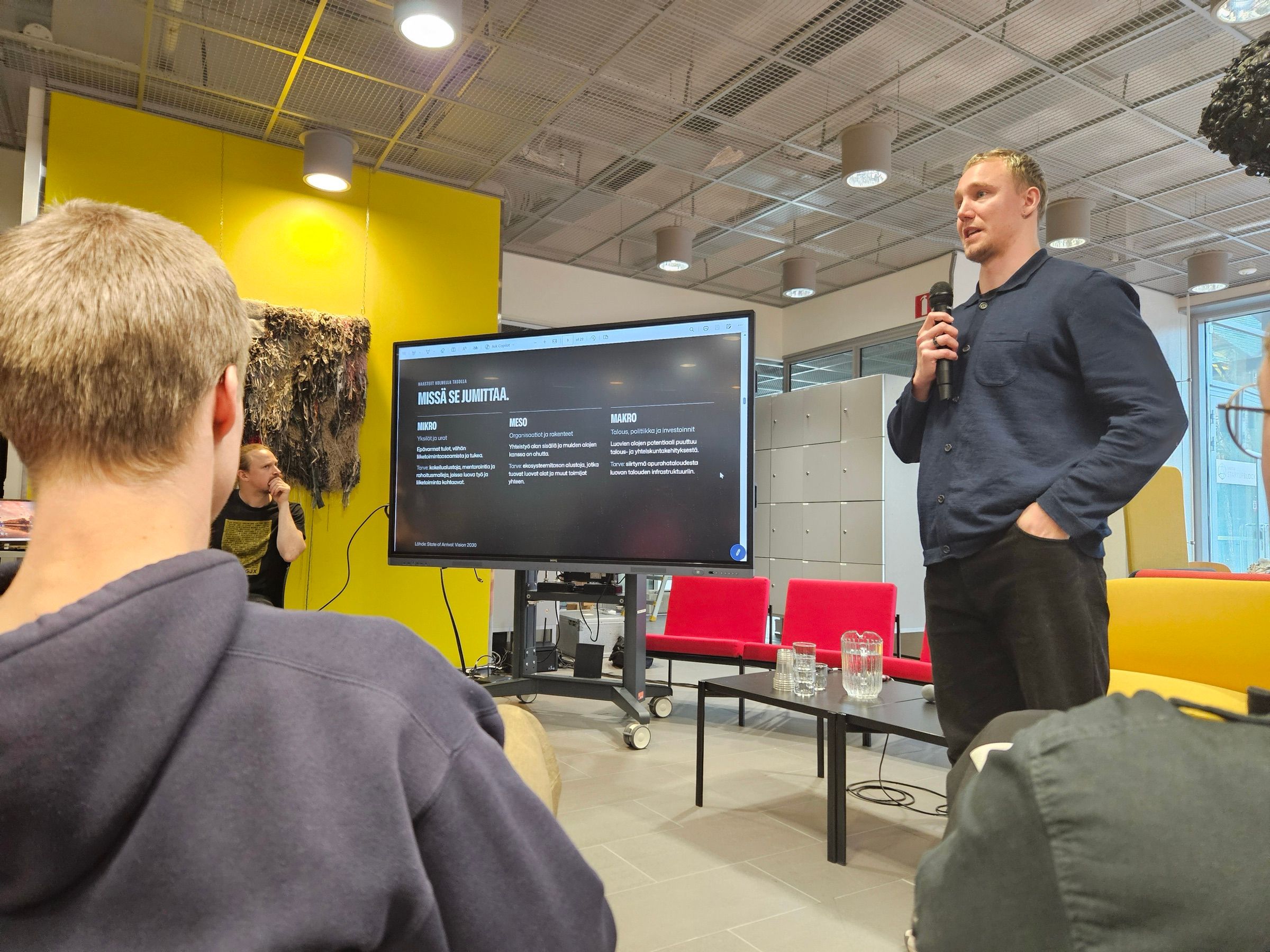
The F-hub is on the ground floor of the Faculty of Art and Design in Rovaniemi. On the first Monday of October it held designers, software people, tourism entrepreneurs, students and the two universities’ project teams. A room full of people asking what creative technology is for, a few kilometres south of the Arctic Circle.
I came with forty minutes and one claim: this is not a culture question any more. It’s a competitiveness question.
The blind spot
Finland has the makers. Talent, cultural capital, international credibility. What’s missing is continuity, infrastructure and connective tissue. The same sentence describes the whole creative sector, and the numbers agree. In 2023 the creative economy was 3.2% of Finland’s GDP. The EU average is 4.4%. The government’s own target for 2030 is 3.5%, below where the EU already is. That gap is billions in potential nobody is using.
Six sources say the same thing in different words: Aalto, two ministries, the national funding agency, the capital’s own strategy and the OECD. Creative skills are at the core of innovation, the sector is structurally underdeveloped, and ecosystems don’t grow on short projects. They grow on continuity, shared spaces and flagship platforms.
We learned that lesson once already. Nokia had the engineering, the global market and a huge head start. When Apple turned the phone from a device into an experience, an identity and an ecosystem, the competition moved to territory Finland didn’t know how to value. Technology without meaning becomes raw material. Creativity isn’t a soft input. It’s a factor of production.
Nobody designed the startup ecosystem
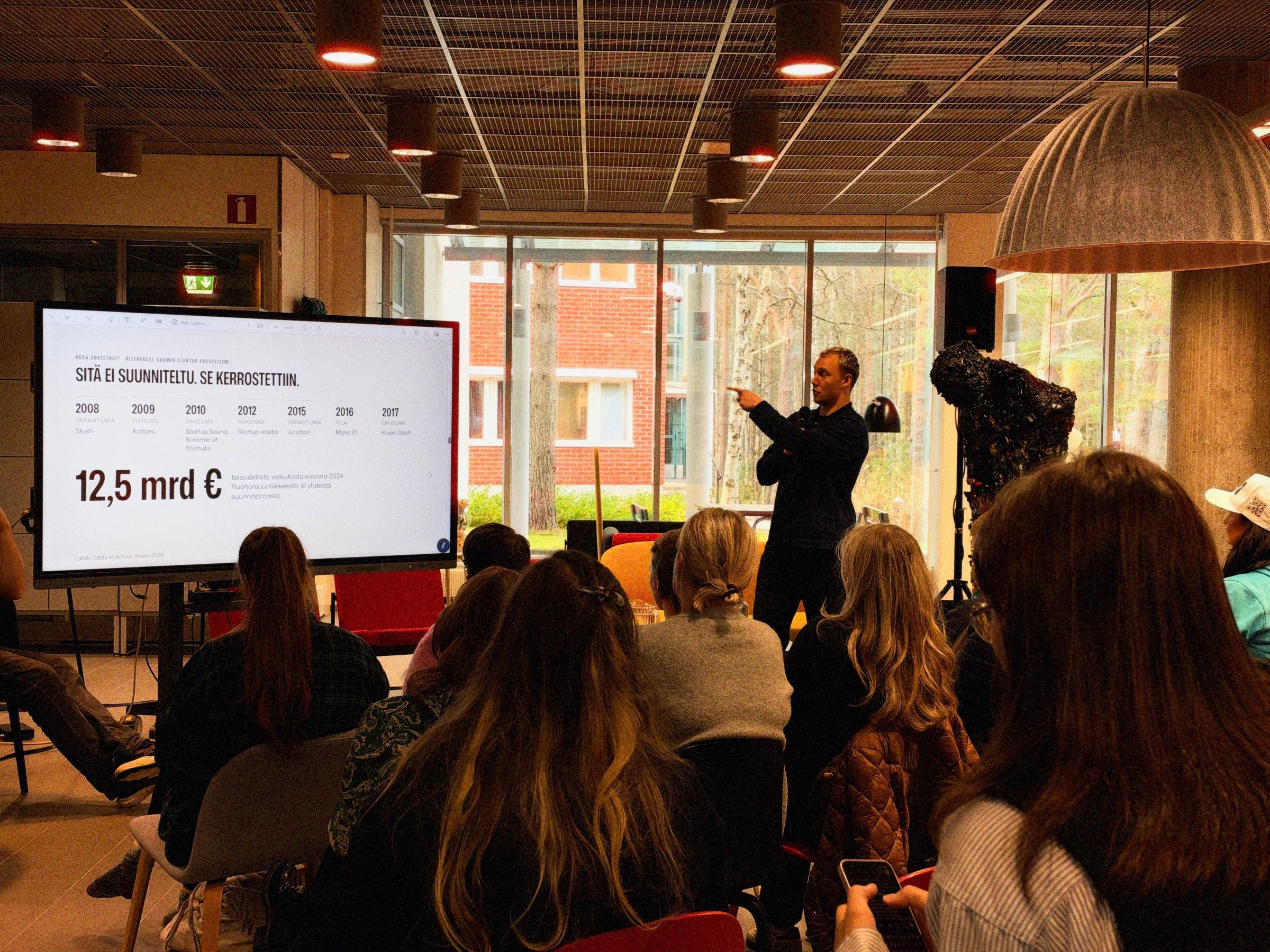
Finland’s startup ecosystem is now put at about €12.5 billion a year for the economy. People talk about it as if someone planned it. Nobody did. It was layered.
An event first: Slush, 2008. Then a community, Aaltoes, 2009. Then programmes, Startup Sauna and Summer of Startups, 2010. A structure, the Startup Foundation, 2012. Another event, Junction, 2015. A space, Maria 01, 2016. More programmes, Kiuas and Dash, 2017. A grassroots movement, not a master plan. Each layer gave the next one somewhere to land.
That’s the whole model. Three layers, applied to the creative economy:
- Events give pace and visibility. The moments when an ecosystem gathers, shows its work and shapes a shared story.
- Spaces give continuity and depth. Everyday infrastructure: work, learning, experiments, community life.
- Programmes give development and scale. The paths that turn creative potential into skills, companies and jobs.
Events make the story, spaces make the community, programmes make the economic result. When the layers reinforce each other, energy accumulates instead of evaporating.
What we’ve tried in Helsinki
ODD doesn’t make culture. It builds around it. We founded New Nordic Way in 2023, in the middle of cultural funding cuts, to test whether the startup world’s best lessons transfer to art and culture. A concept in February 2025, the first ODDfest in June in the Lasipalatsi block. In 2026, ODDference and ODDspace alongside the festival.
Two years in: more than 5,000 participants, 500+ collaborators, 100+ partners, and over €400,000 straight to creative and cultural professionals. The numbers aren’t the point. The change is.
Six things we learned, in the order we learned them:
- Start with an event. It’s the fastest way to bring scattered people together, test demand and build trust before you build anything permanent.
- An event ignites, but it doesn’t carry. Without a place to come back to, the energy scatters and the next time starts from zero. That’s why ODDspace exists.
- A genuine invitation gathers everyone. Makers, companies, teachers, decision-makers and investors sit in the same room when the content means something.
- Neutrality is an asset. Not tied to one art form, one company or one ministry, you can convene across silos.
- Every product needs a job. In 2026 the week, the festival and the conference all ran under the ODDfest name. Too much for one name. For 2027: four products, four jobs.
- Good intentions need good economics. Build programmes only when the need is clear and the funding is enough to do them properly.
Three views on CreaTech
First, AI moves the competition. When production, analysis and content get cheap, making things no longer sets you apart. What does is being interesting, feeling genuine and earning trust.
Second, creative skills belong in the core questions, not the decoration. They still get invited when the strategy needs a visual. Their place is where the question is asked: why do people choose us?
Third, zoom out of games. CreaTech’s biggest value comes when creative technology meets the strong industries: tourism, retail, manufacturing, services. In Lapland that means tourism first, which is why the day ended with a panel on exactly that.
Where to start
For a company: take creative skill to the core growth question. Start with the question, not the format.
For a maker: package your skill as an answer to a company’s question, not as a portfolio. Look outside your own field, at the strong industries.
For a developer of a region: layer the meetings, the spaces and the paths. Measure what happens before growth.
A light experiment is enough to begin. One company, one maker, one question, one small paid prototype.
Measure what happens before growth
Turnover, jobs and GDP are the ministry’s numbers, and a single actor can’t move them directly. What an actor can move are the things that come before: how often people meet, how many unique people take part, how many come back within a year, how many collaborations turn into a contract or a product, how many new companies and collectives form, how many euros go directly to makers, and how participants’ own turnover grows because they were there. We’ve written that set of measures down as an open one, so a region can use it without asking us.
The model, the metrics and the lessons are free to copy and adapt. A good tool is half the work: a shared language, a repeatable way of doing things, and an open door.
The panel: CreaTech and tourism
After the keynote I sat down with four Lapland entrepreneurs. Miikka Niemi of Flatlight Creative, Karoliina Keskikallio of Adventure Park Pyhäkuru, Teemu Sara of Bearhill Husky and Suvi Männikkö of Ranch Kuulas, with Heikki Tikkanen from ACT ONE moderating.
Heikki opened with one question for all of us, with a minute each: name one thing in your business that didn’t exist before you made it.
For me the honest answer is ODDfest. Helsinki had Design Week and Slush. Nothing put the creative sector as a whole on one stage with business, in one week, under one invitation. So we made one: a concept in February 2025, the first week in June 2025. The lesson I keep repeating is the first of the six above. Start with an event. It’s the fastest way to find out whether scattered people want to be in the same room, before you build anything permanent.
I won’t put words in the four entrepreneurs’ mouths; the day was streamed, and their answers are theirs. What I can say is what the line-up itself said. Flatlight is a creative agency in Rovaniemi. Pyhäkuru is an adventure park in the fells. Bearhill Husky runs husky safaris outside Rovaniemi. Ranch Kuulas takes people out on horseback. None of them is a technology company. All of them already sell experiences, which is what creative technology is supposed to add to, not replace. My reading of the hour: the region isn’t short of ideas. It’s short of the first small paid experiment, and of someone to say who pays for it.
What I took home
- The ecosystem is a method, not a place. Events, spaces, programmes. Layer them anywhere.
- Tourism is the obvious host industry for CreaTech in the north. The question is who convenes it.
- A region doesn’t need a master plan. It needs a first event, and the patience to layer.
What I’m still thinking about
A tourism entrepreneur in Lapland has a season, a staff and a product that works. Why spend money on an experiment? My answer is that the next thing visitors pay for won’t be the safari. It’ll be the story around it, and somebody has to make that. The honest version of my talk is that the model needs a convener in the region: someone neutral enough to get the agency, the ranch and the university into one room more than once. Luote is built to be that room in Rovaniemi. The layering has started.
The invitation from my last slide stands. Take the model. Tell us what worked. And bring your own makers to Helsinki: ODDfest 2027 is collecting event ideas now, and an idea doesn’t have to be ready.
The questions I was asked
- Name one thing in your business that didn’t exist before you made it.
- What added value could new creative-technology ideas bring to tourism?
- What light, cross-sector experiments could we start with?
Thank you to ACT ONE and Luote at the University of Lapland and Lapland UAS for the invitation, to Heikki Tikkanen for making the day happen, and to Kristian Gummerus for the introduction.